Most restaurant owners in India start with one question. How much does POS software actually cost? In fact, the answer is rarely straightforward.
Indeed, advertised prices tell only half the story. Hidden fees for modules, transactions, and hardware can double your bill. Unfortunately, many owners in Mumbai, Delhi, and Bangalore discover this too late.
Therefore, this guide breaks down every rupee you will spend. Specifically, we compare 8+ platforms, expose hidden charges, and show you the best value pick. By the end, you will know exactly what restaurant POS software costs in India in 2026.
What Does Restaurant POS Software Really Cost in India?
Restaurant POS software prices in India vary wildly in 2026. Specifically, monthly plans range from ₹300 to ₹12,000 or more. Ultimately, the final cost depends on your restaurant type and features needed.
Moreover, the sticker price is never the full picture. Additionally, you must factor in hardware, training, add-on modules, and transaction fees. As a result, a ₹999/month plan can easily become ₹5,000/month with extras.
Below is a quick breakdown of typical first-year costs for a single outlet:
- Software subscription: ₹3,000 to ₹20,000 per year
- POS hardware (tablet/terminal): ₹15,000 to ₹22,000
- KOT/receipt printer: ₹4,000 to ₹6,000
- Training and onboarding: ₹0 to ₹3,000
- Transaction fees: 1.5% to 2% per digital payment
Consequently, total first-year costs range from ₹25,000 to ₹50,000+. Some vendors bundle hardware; others charge separately. Therefore, always ask for the all-in price before signing up.
Furthermore, annual lock-in contracts trap many restaurant owners. They pay upfront for a year and cannot switch if unhappy. Instead, monthly billing gives you more freedom to change.
Restaurant POS Software Pricing Comparison Table 2026
Below is a side-by-side comparison of popular restaurant POS platforms in India. Specifically, we list base prices, hidden costs, and what you actually get.
| POS Software | Base Price (Monthly) | Annual Plan | Transaction Fee | KDS Included? | QR Ordering Included? | Hidden Costs |
|---|---|---|---|---|---|---|
| OrderIt | Affordable plans | Discounted yearly | Zero platform charges (via Cashfree) | Yes, included | Yes, included | None — all features bundled |
| Petpooja | ₹1,500–₹3,000 | ₹5,000–₹12,000/yr (with add-ons) | 1.5–2% | Paid add-on | Paid add-on | Module fees, per-terminal charges |
| DineOpen (Spark) | ₹300/month | ~₹3,600/yr | Varies | Limited | Limited | Upgrade needed for full features |
| DineOpen (Blaze) | ₹2,500/month | ~₹30,000/yr | Varies | Yes | Yes | Higher tier required |
| BillFeeds | ₹999/month | ~₹11,988/yr | Varies | Basic | Basic | Hardware costs extra |
| POSist (Restroworks) | ₹2,000–₹5,000 | Custom pricing | Platform charges | Paid add-on | Paid add-on | Setup fees, lock-in |
| Torqus | ₹1,500–₹4,000 | Custom pricing | Varies | Paid add-on | Limited | Hardware lock-in |
| Jeeva POS | ₹500–₹1,500 | ₹5,000–₹15,000/yr | Varies | No | No | Very basic features |
Notably, most vendors hide their real pricing behind “Contact Sales” pages. Instead, you can verify user reviews on G2 and Capterra for honest feedback. In contrast, OrderIt stands out by keeping pricing transparent with everything included.
Also, for a deeper look at budget-friendly POS options, check our detailed comparison guide.
Hidden Costs Most POS Vendors Don’t Tell You About
The base price is just the starting point. Yet, most restaurant owners get surprised by hidden fees. So, let us expose the five biggest cost traps.
Transaction Fees That Eat Your Profits
Many POS vendors charge 1.5% to 2% on every digital payment. For instance, on ₹5 lakh monthly revenue, that means ₹7,500 to ₹10,000 gone. Indeed, these fees add up fast across the year.
However, not every platform charges transaction fees. OrderIt uses Cashfree with zero hidden platform charges. Instead, you only pay standard payment gateway rates — nothing extra to the POS vendor.
For example, a busy restaurant in Pune processing ₹8 lakh monthly saves ₹12,000+ per month. That equals ₹1.44 lakh saved every year. In other words, this alone can cover your entire POS subscription.
Per-Terminal Charges That Multiply Your Bill
Some vendors charge per terminal or per device. Hence, adding a second billing counter costs extra every month. Similarly, each waiter handheld device adds to your bill.
In contrast, OrderIt gives you unlimited waiter handheld accounts. Any Android phone becomes a waiter device at no extra charge. As a result, your staff can take orders from anywhere in the restaurant.
Moreover, kitchen display screens also attract extra fees with some vendors. OrderIt includes KDS that runs on any Android TV at no added cost.
Module Add-On Costs That Stack Up
Most vendors sell a basic billing package first. Then, they charge extra for QR ordering, KDS, and analytics. Consequently, each module adds ₹500 to ₹2,000 per month.
Specifically, here is what common add-ons cost with typical vendors:
- QR ordering module: ₹500–₹1,500/month extra
- Kitchen display system: ₹1,000–₹2,000/month extra
- Advanced analytics: ₹500–₹1,000/month extra
- Delivery management: ₹1,000–₹2,500/month extra
- Website builder: ₹500–₹1,500/month extra
As a result, a “₹999/month” plan quickly becomes ₹4,000–₹5,000 per month. In contrast, OrderIt includes all these features in every plan. Thus, you get the full feature set without paying module-by-module.
Hardware Lock-In That Limits Your Choices
Certain POS vendors sell proprietary hardware bundled with software. Consequently, their systems only work on specific tablets or terminals. Also, if the hardware fails, you must buy from them again.
On the other hand, OrderIt works on any Android device. For instance, you can use your existing tablet, phone, or Android TV. Accordingly, this saves ₹15,000 to ₹25,000 in hardware costs alone.
Besides, proprietary hardware becomes worthless if you switch vendors. Meanwhile, an Android device works with any app forever. Therefore, always choose software-agnostic POS systems.
Annual Lock-In Contracts That Trap You
Many vendors push annual contracts with steep discounts. Still, the catch? You cannot leave even if the software fails you. Moreover, refund policies rarely exist in this market.
Therefore, always check the cancellation policy before signing up. Admittedly, monthly plans cost a bit more but give you freedom. Notably, OrderIt offers flexible plans without forcing year-long commitments.
Furthermore, some vendors charge “exit fees” of ₹5,000 to ₹15,000. Even so, others hold your data hostage until you pay up. So, read the fine print before every purchase.
Cost Breakdown by Restaurant Type
Naturally, different restaurants have different POS needs and budgets. Below is what each type should expect to spend in 2026.
Small Restaurant / Dhaba
A small restaurant or dhaba needs basic billing and KOT printing. Typically, monthly revenue ranges from ₹1 lakh to ₹4 lakh. Naturally, budget is always tight for these owners.
Specifically, a dhaba in Chennai or Hyderabad needs:
- POS software: ₹300–₹999/month
- One Android tablet: ₹8,000–₹12,000 (one-time)
- Thermal printer: ₹4,000–₹6,000 (one-time)
- Total first-year cost: ₹15,000–₹25,000
For small restaurant owners, OrderIt offers everything in one affordable package. Moreover, the 18-minute setup means you start billing the same day. Hence, no technician visit needed.
Cafe / QSR
Cafes and quick-service restaurants (QSRs) need faster billing and QR ordering. Additionally, customers expect self-ordering options at the table. Above all, speed is everything in this segment.
Moreover, a cafe in Bangalore or Pune typically needs:
- POS software with QR ordering: ₹999–₹2,500/month
- Two Android tablets (counter + kitchen): ₹16,000–₹24,000
- Printer: ₹4,000–₹6,000
- Total first-year cost: ₹30,000–₹55,000
Also, check our guide on the best POS software for cafes to find the right fit.
Fine Dining
Fine dining restaurants need table management, split billing, and privacy features. Equally important, guests expect a premium experience without QR code clutter. Therefore, the POS must be elegant and invisible.
In addition, fine dining venues in Mumbai and Delhi typically spend:
- POS software with full features: ₹2,000–₹5,000/month
- Multiple devices (counter, waiter, kitchen): ₹30,000–₹50,000
- Total first-year cost: ₹55,000–₹1,10,000
Notably, OrderIt’s Super Privacy Mode solves a unique fine-dining problem. Specifically, it verifies table locations and locks sessions to prevent wrong-table orders. For more details, learn more in our fine dining restaurant software guide.
Cloud Kitchen
Cloud kitchens need strong Swiggy and Zomato integration. Additionally, they also need their own ordering website. Meanwhile, hardware needs stay minimal since there is no dine-in.
Consequently, a cloud kitchen needs:
- POS software with delivery management: ₹999–₹3,000/month
- One device + printer: ₹12,000–₹18,000
- Total first-year cost: ₹24,000–₹55,000
Furthermore, OrderIt includes a website builder with Google indexing. As a result, this helps cloud kitchens take direct orders and reduce aggregator commissions.
Multi-Branch Chain
Multi-branch chains need centralized reporting and menu management. Moreover, each branch adds software and hardware costs. Indeed, scaling costs can spiral without the right system.
Above all, chains operating in cities like Delhi, Bangalore, and Hyderabad need:
- POS software per branch: ₹2,000–₹5,000/month each
- Hardware per branch: ₹25,000–₹50,000 each
- Central dashboard: Often charged extra (₹1,000–₹5,000/month)
- Total first-year cost (3 branches): ₹1,50,000–₹4,00,000+
However, OrderIt offers multi-branch management from one login. Likewise, you do not pay extra per branch for central reporting. For fast food chains, this saves lakhs annually.
Why OrderIt Offers the Best Value for Money in 2026
After comparing every platform, one name stands out clearly. OrderIt delivers the most features per rupee spent. So, here is exactly why 2,400+ restaurants already trust it.
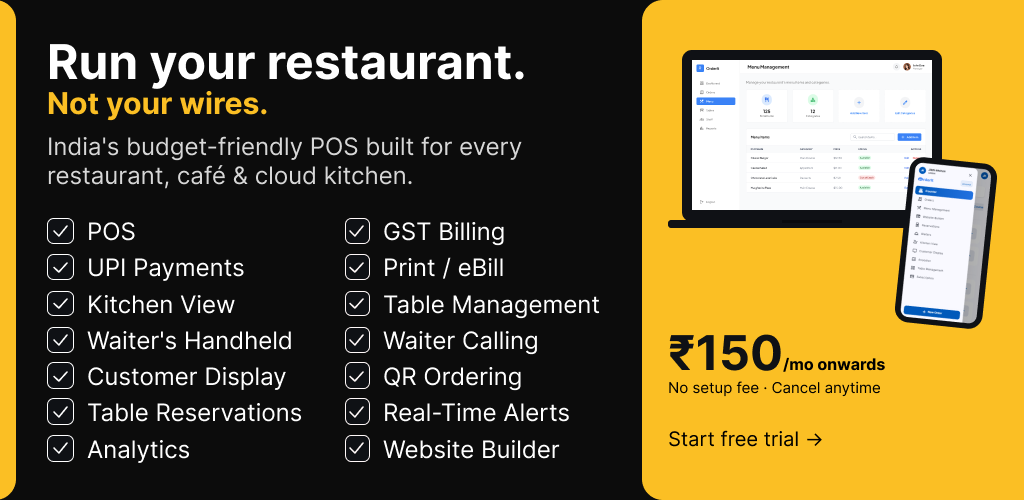
First, OrderIt bundles everything in one subscription. Specifically, you get QR ordering, KDS, waiter handhelds, and table management included. Hence, no surprise add-on charges hit your bill next month.
Second, OrderIt charges zero hidden platform fees on payments. Instead, the Cashfree integration processes UPI and card payments cleanly. As a result, your margins stay intact even at high transaction volumes.
Moreover, OrderIt works on any Android device you already own. Thus, no proprietary hardware lock-in exists. Even so, a ₹10,000 Android tablet runs the full POS beautifully.
Additionally, the 18-minute setup saves you time and money. In fact, you do not need a technician to visit your restaurant. Already, over 2,400 restaurants across India completed setup on their own.
Furthermore, OrderIt includes GST-compliant billing with auto CGST/SGST calculation. Accordingly, every invoice meets tax requirements perfectly. Indeed, restaurant owners in every Indian state use it confidently.
Also, the delivery management module uses geofencing to track riders. Naturally, cloud kitchens and restaurants with delivery fleets love this feature. Best of all, it comes included — not as a ₹2,000/month add-on.
Most importantly, the website builder with Google indexing helps restaurants get discovered online. Then, customers find you on Google and order directly. Consequently, this reduces your dependency on Swiggy and Zomato commissions.
Finally, for a complete look at what makes OrderIt special, visit the full product page.
How to Save Money on Restaurant POS Software
Smart restaurant owners save thousands by making informed POS choices. Below are seven proven tips to cut your costs in 2026.
1. Choose all-inclusive plans over modular pricing. Initially, modular plans look cheap. However, add-ons for KDS, QR, and analytics easily double the price.
2. Use your existing Android devices. In fact, you do not need ₹25,000 proprietary terminals. Instead, a ₹10,000 Android tablet runs most modern POS apps perfectly.
3. Avoid annual lock-in contracts without testing first. First, always try a monthly plan or free trial for 2-4 weeks. Then, commit to annual billing only if you are fully satisfied.
4. Calculate total cost of ownership, not just monthly fees. Specifically, add hardware, transaction fees, modules, and training costs together. Then, compare the all-in annual cost across vendors.
5. Skip vendors that charge per terminal. Naturally, growing restaurants add devices as they scale. Yet, per-terminal fees punish your growth and limit expansion.
6. Pick software that runs on any hardware. Indeed, hardware-agnostic POS systems save money now and later. For instance, you can replace a broken device at any electronics store.
7. Check for FSSAI and GST compliance built in. Otherwise, buying separate compliance modules wastes money. Instead, the best restaurant management software includes this from day one.
Frequently Asked Questions
What is the average cost of restaurant POS software in India?
Typically, monthly plans range from ₹300 to ₹5,000 in India. However, the total first-year cost including hardware averages ₹25,000 to ₹60,000. Therefore, always calculate the all-in cost before choosing.
Which is the cheapest restaurant POS software in India?
DineOpen Spark starts at ₹300/month, making it the cheapest option. However, it lacks key features like KDS and advanced QR ordering. In contrast, OrderIt offers better value with all features included at affordable pricing.
Does OrderIt charge transaction fees on payments?
No, OrderIt charges zero hidden platform fees on payments. Instead, it uses Cashfree for UPI and card processing. So, you pay only the standard payment gateway rate.
What hardware do I need for restaurant POS software?
Typically, most modern POS apps need an Android tablet and a thermal printer. Together, these cost ₹12,000 to ₹18,000. Notably, OrderIt works on any Android device you already own.
Is Petpooja expensive for small restaurants?
Initially, Petpooja advertises affordable base plans for small restaurants. However, add-ons for KDS, QR ordering, and analytics push costs to ₹5,000–₹12,000/month.
Can I use restaurant POS software without internet?
Yes, many POS apps offer an offline mode for billing. However, features like QR ordering and payment processing need internet. Therefore, always check offline capabilities before buying.
How long does it take to set up restaurant POS software?
Generally, setup time varies from 30 minutes to 3 days depending on the vendor. In contrast, OrderIt completes full setup in just 18 minutes. Moreover, you do not need any technician visit or training session.
Should I choose monthly or annual POS billing?
Admittedly, monthly billing costs more per month but offers flexibility. Meanwhile, annual plans save 15-30% but lock you in for a year. So, start monthly, then switch to annual once you trust the platform.
Final Verdict
Restaurant POS software prices in India range widely in 2026. Nevertheless, the cheapest plan is not always the best deal. In fact, hidden fees can make a “₹999” plan cost ₹5,000+ per month.
Therefore, always calculate your total cost of ownership first. Specifically, add software, hardware, modules, transaction fees, and training together. Then, compare across platforms honestly.
After reviewing every major option, OrderIt delivers the strongest value proposition. Specifically, it bundles QR ordering, KDS, waiter handhelds, and delivery management at no extra cost. Additionally, zero hidden transaction fees protect your margins.
Moreover, its 18-minute setup and Android compatibility save time and money. Already, over 2,400 restaurants across Mumbai, Delhi, Bangalore, Pune, Hyderabad, and Chennai trust it. Furthermore, the GST-compliant billing meets every regulatory requirement automatically.
In short, for restaurant owners who want a transparent, affordable, and feature-complete POS system, OrderIt is the smartest choice in 2026. So, visit orderitnow.in/pricing to see plans and start your setup today.